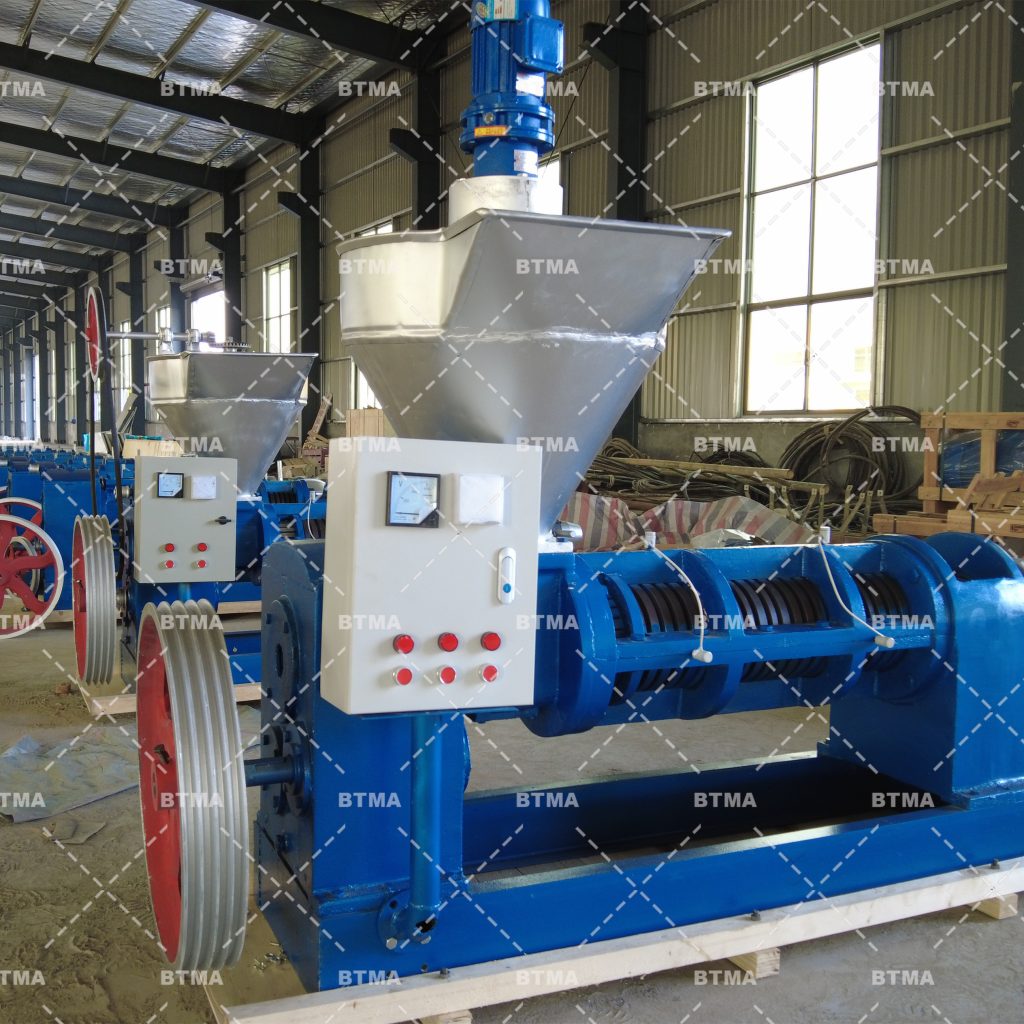
Regular maintenance can significantly reduce unexpected downtime and help an oil press machine maintain stable performance over a longer period.
Many oil press problems do not appear suddenly. Reduced oil output, increasing vibration, abnormal noise, rising temperature, or wetter press cake may appear before a major mechanical failure.
A simple maintenance routine allows operators to identify these warning signs earlier.
Daily Oil Press Machine Maintenance
Daily maintenance should start with cleaning.
After production, remove oil cake and residue from the feeding area, pressing chamber area, discharge outlet, and other accessible parts.
Oil residue should not be allowed to accumulate around moving or heat-generating components.
The operator should also check whether there is any abnormal oil leakage, loose fastener, unusual vibration, or unusual sound.
A quick inspection only takes a few minutes but can prevent small problems from becoming expensive repairs.
Check the Screw Pressing System
The screw shaft is one of the most important working components of a screw oil press.
During routine maintenance, observe whether the screw shows obvious wear, deformation, scratches, or unusual polishing.
If the press cake becomes increasingly oily while the raw material remains unchanged, worn pressing components may be one possible cause.
Do not wait until the machine completely stops before inspecting the pressing system.
Check Bearings and Lubrication
Bearings support rotating components and are important for smooth operation.
Insufficient lubrication, contamination, misalignment, or long-term wear can cause increased friction and temperature.
Follow the lubrication recommendations supplied with the specific machine.
Do not simply add more lubricant whenever a component becomes hot. Excessive lubrication can also cause problems, while the correct lubricant type and quantity are important for reliable operation.
Weekly Maintenance
For machines used regularly, a more detailed inspection should be performed periodically.
Check the transmission system, belts, chains, fasteners, electrical connections, lubrication points, and accessible pressing components.
Look for loose screws or bolts.
Check whether belts are excessively loose or worn.
Inspect electrical cables for damage.
Check whether the machine remains securely installed on a level foundation.
These inspections are particularly important for machines operating for long hours every day.
Monthly Maintenance
A monthly inspection can focus on the condition of major components.
Inspect the screw shaft, pressing chamber, pressing bars or related wear components, bearings, gearbox, and discharge mechanism.
If the machine has been operating under heavy production conditions, maintenance intervals may need to be shortened.
The correct maintenance schedule depends on operating hours, raw material characteristics, production conditions, and the machine design.
Keep the Oil Press Dry and Clean
Oil press machines are often used in environments where oil, dust, seed particles, and moisture are present.
Keeping the equipment clean reduces the accumulation of residue and makes it easier to identify oil leakage or mechanical problems.
After cleaning, allow components to dry properly.
If the machine will not be used for an extended period, clean the equipment thoroughly and protect appropriate metal surfaces against rust.
Do Not Ignore Small Changes
A machine does not always fail without warning.
A small change in sound may indicate a loose component.
Increasing vibration may indicate imbalance, wear, or installation problems.
A gradual decrease in oil output may indicate changes in raw material conditions or wear of pressing components.
An increase in motor load may indicate excessive feeding, blockage, mechanical friction, or other problems.
Operators should pay attention to trends instead of waiting for a complete failure.
Create a Simple Maintenance Record
A maintenance record can include:
- Operating hours.
- Raw material processed.
- Cleaning date.
- Lubrication date.
- Abnormal noise or vibration.
- Oil output changes.
- Replaced wearing parts.
- Electrical or mechanical repairs.
This information helps operators identify recurring problems and plan spare parts before an emergency occurs.
Maintenance Is Cheaper Than Unexpected Downtime
For an oil processing business, an oil press is a production machine rather than simply a piece of equipment.
When the machine stops unexpectedly, the impact may include lost production, delayed orders, additional labor, and emergency repair costs.
Regular maintenance is therefore part of production management.
A few minutes of inspection every day can be much more valuable than waiting for a major breakdown.