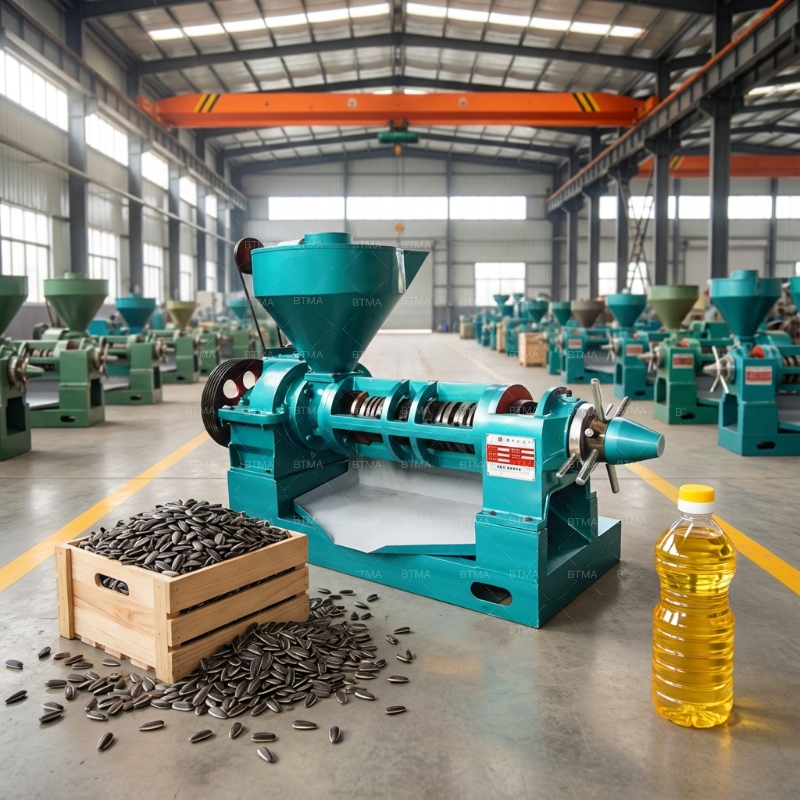
Freshly pressed oil is not always ready to be stored for a long period immediately after leaving the oil press machine.
Mechanical pressing normally produces crude oil containing fine seed particles, suspended solids, and sometimes a small amount of moisture. After pressing, proper handling and storage are important for maintaining oil appearance, quality, and stability.
For small oil workshops and commercial oil processing businesses, understanding how to handle freshly pressed oil can help reduce unnecessary losses and create a more consistent production process.
Why Does Freshly Pressed Oil Need Proper Storage?
Oil that comes directly from a mechanical press may contain small particles from the raw material.
If these particles are allowed to remain in the oil for a long time, they can settle at the bottom of the container and affect the appearance of the finished product.
Improper storage can also expose the oil to excessive air, heat, light, moisture, or contamination.
Therefore, oil storage should be considered an important stage after pressing rather than simply transferring the oil into any available container.
Filter the Oil Before Long-Term Storage
One of the first considerations after mechanical pressing is filtration.
The crude oil can contain fine particles of seed material and other suspended solids. A suitable oil filtration system can remove these particles before the oil enters the storage tank.
For a small oil workshop, the process may be:
Oil Press → Oil Collection → Filtration → Clean Oil Storage → Filling
The exact filtration method depends on the raw material, production capacity, and desired oil quality.
Some small oil presses may integrate vacuum filtration, while larger production systems may use separate filtration equipment.
Choose a Suitable Storage Container
The storage container should be clean, dry, and suitable for edible oil.
For commercial production, storage tanks are generally more convenient than using many small containers.
A properly arranged storage tank can make it easier to collect, transfer, inspect, and package the oil.
The tank should also be easy to clean.
When designing an oil production workshop, operators should leave sufficient space around storage tanks for inspection, cleaning, and oil transfer.
Keep Water Away From Stored Oil
Water can negatively affect the stability of stored oil.
Freshly pressed oil should therefore be protected from unnecessary moisture during collection and storage.
Storage containers should be dry before filling.
If the production process involves washing equipment, make sure the relevant equipment and containers are properly dried before they come into contact with the oil.
This is particularly important for small workshops where the pressing, filtration, and storage areas may be close together.
Protect Oil From Excessive Heat
High temperatures can accelerate changes in edible oil during storage.
For this reason, oil storage areas should not be unnecessarily exposed to strong heat sources.
Avoid placing storage containers directly beside equipment that produces significant heat.
For commercial oil processing, controlling the storage environment can be especially important when the oil is stored for a longer period before packaging or sale.
Reduce Unnecessary Exposure to Air
Oil can react with oxygen over time.
For this reason, repeatedly opening storage containers or leaving oil exposed to air for long periods is not ideal.
A well-organized production system should minimize unnecessary transfers between open containers.
After filtration, oil can be transferred directly into a clean storage tank and then into packaging equipment when required.
Protect Oil From Light
Light exposure can also affect the stability of some edible oils.
Therefore, oil should preferably be stored in a suitable environment rather than being exposed to strong sunlight for extended periods.
For commercial production, the storage area should be arranged so that finished oil is protected from unnecessary environmental exposure.
Avoid Mixing Different Types of Oil
If a workshop processes several different oilseeds, storage management becomes even more important.
Peanut oil, sunflower oil, rapeseed oil, soybean oil, and other vegetable oils should be clearly identified.
Separate storage containers can help prevent accidental mixing.
The same principle applies to different customer batches when a workshop provides oil pressing services.
Clear labeling can help identify:
- Oil type.
- Production date.
- Raw material.
- Batch number.
- Filtration status.
This simple system can make production management much easier.
How Long Can Freshly Pressed Oil Be Stored?
There is no single storage period that applies to every type of oil.
Shelf life depends on the raw material, processing method, filtration level, moisture, temperature, packaging, oxygen exposure, light exposure, and other factors.
Therefore, producers should not use one fixed storage period for every vegetable oil.
If the oil is intended for commercial sale, storage conditions and shelf-life requirements should also comply with applicable local food regulations.
A Practical Oil Storage Workflow
For a small or medium oil workshop, a basic workflow can be organized as:
Raw Material → Oil Press → Crude Oil Collection → Filtration → Clean Oil Storage → Filling and Packaging
This arrangement reduces unnecessary movement of oil and makes the production process easier to manage.
For larger businesses, additional refining, deodorization, cooling, or automated filling equipment may be added depending on the final product.
Why Oil Storage Should Be Considered When Planning an Oil Mill
Customers often focus on the oil press machine when planning an oil production business.
However, the press is only one part of the production process.
The workshop may also require:
- Raw material storage.
- Seed cleaning equipment.
- Oil press machine.
- Oil filtration equipment.
- Oil storage tanks.
- Transfer pumps.
- Filling equipment.
- Packaging equipment.
A suitable storage system allows the oil produced by the press to move smoothly to the next production stage.
Final Thoughts
Good oil storage begins immediately after pressing.
Filtering the crude oil, using clean containers, protecting the oil from excessive heat and light, reducing unnecessary exposure to air, and keeping different oils clearly separated can all contribute to better storage management.
For businesses selling freshly pressed edible oil, proper storage is not simply a technical detail. It is an important part of maintaining consistent product quality from the oil press to the final customer.