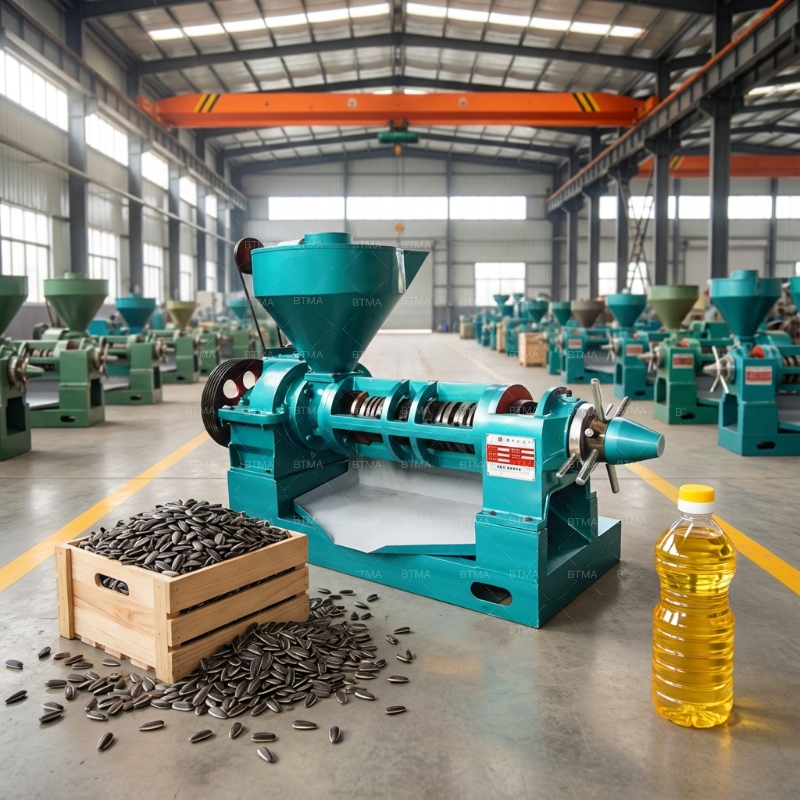
Can One Oil Press Process Different Oilseeds?
Many screw oil press machines are designed to process several types of oil-bearing materials.
For example, a suitable screw oil press may be used for peanuts, soybeans, sunflower seeds, rapeseed, mustard seeds and other compatible oilseeds. However, using the same machine does not mean every crop should be processed under identical conditions.
Different seeds have different oil content, hardness, moisture, size and physical characteristics.
When changing from one oilseed to another, the production process should therefore be adjusted accordingly.
Why Should the Machine Be Cleaned Before Changing Raw Materials?
Residual material from the previous crop can remain inside the hopper, pressing chamber, oil collection area and cake outlet.
If the next crop is a different type of seed, these residues can mix with the new material.
This can affect product consistency and may be particularly important when producing different types of edible oil.
Cleaning the material-contact areas before changing crops can help reduce cross-contamination between different batches.
Step 1: Finish the Previous Batch
Before changing raw materials, allow the previous material to pass through the pressing system as far as practical.
The operator should avoid leaving a large amount of the previous seed inside the pressing chamber.
After production stops, the machine should be shut down according to the manufacturer’s operating procedure.
Step 2: Clean the Feeding Area
The hopper and feeding section should be checked for remaining seeds and foreign materials.
Any accumulated material should be removed before the new raw material is introduced.
The same applies to the oil collection area and cake discharge section.
Step 3: Clean the Pressing Chamber
Depending on the machine design, the pressing chamber and related components may need cleaning between different crops.
This is particularly important when switching between materials with noticeably different physical properties.
Maintenance work should always be carried out with the machine stopped and the power source isolated.
Step 4: Prepare the New Oilseed
The new crop should not simply be poured into the machine without checking its condition.
The operator should consider:
- Cleanliness
- Moisture
- Seed size
- Shell content
- Crushing requirements
- Heating or conditioning
- Feeding characteristics
Some materials may require crushing, shelling, heating or other preparation before pressing.
Step 5: Adjust the Pressing Conditions
The pressing conditions may need to be changed when switching crops.
For example, the appropriate cake outlet adjustment for peanuts may not be the same as the adjustment used for sunflower seeds.
The goal is to establish stable feeding, suitable pressure and consistent cake discharge for the new material.
Step 6: Run a Small Test
Before starting a full production run, a short test can be useful.
During the test, observe:
- Feeding stability
- Oil flow
- Cake discharge
- Machine load
- Noise and vibration
- Oil appearance
If the results are not satisfactory, the operator can make adjustments before processing a larger quantity of raw material.
Why Is This Important for Multi-Seed Oil Mills?
Businesses that process several crops throughout the year can benefit from using flexible oil processing equipment.
For example, a local oil mill may process peanuts during one season and sunflower seeds or rapeseed during another.
Instead of installing a completely separate production line for every crop, a suitable multi-purpose oil press can serve as the main pressing unit.
However, the upstream preparation and pressing conditions still need to be adapted to each crop.
What About Oil Filtration?
Changing raw materials also means paying attention to the filtration process.
Different crops can produce crude oil with different amounts and types of suspended particles.
The filtration system should therefore be cleaned and maintained appropriately when changing products.
If the business sells different oils separately, the storage tanks and transfer equipment should also be managed carefully to prevent unwanted mixing.
How Can Operators Make Crop Changes More Efficient?
A simple changeover checklist can help:
Stop Previous Production → Clean Machine → Prepare New Oilseed → Adjust Press → Test Pressing → Check Oil and Cake → Start Full Production
Keeping records for each crop can make future changeovers easier.
Operators can record preparation conditions, pressing adjustments, production performance and maintenance observations for each major raw material.
Conclusion
Using one oil press for several oilseeds can provide useful production flexibility, but each crop should be treated as a separate processing condition.
Cleaning the machine, preparing the new raw material, adjusting the pressing conditions and performing a short test before full production can help maintain stable operation.
For businesses processing several seasonal crops, a well-managed changeover procedure can be just as important as choosing a versatile oil press machine.