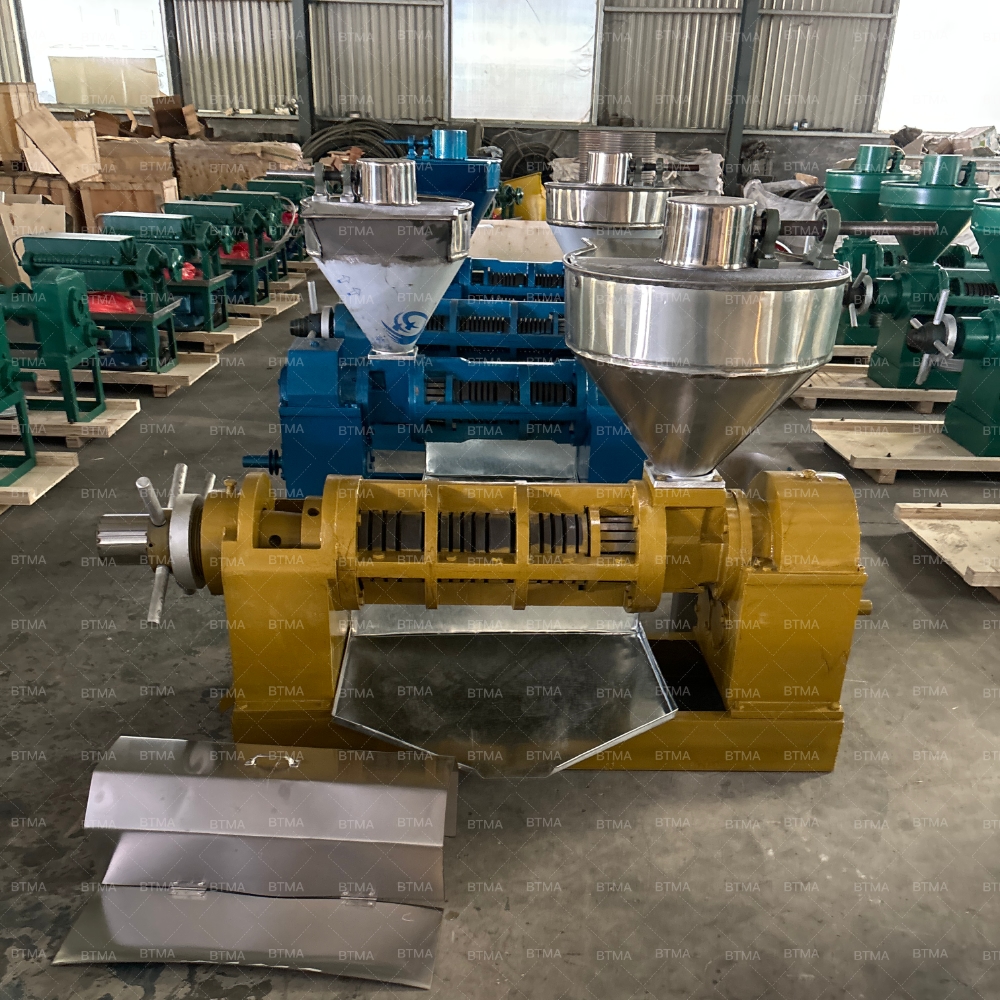
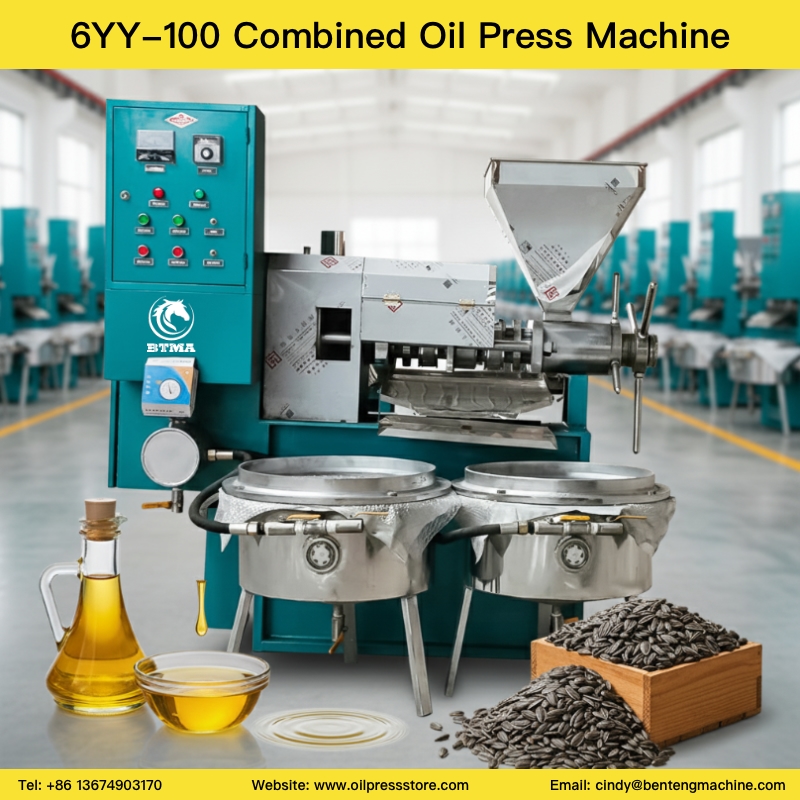
What Makes High-Capacity Oil Processing Different?
When an oil business reaches a higher production level, equipment selection becomes part of a much larger production planning problem. The business needs enough raw materials, storage capacity, labor and downstream processing equipment to support the oil press. Simply purchasing a high-output machine does not guarantee high daily production if the rest of the workshop cannot keep up. The 6YL-208 Combined Oil Press Machine is designed for high-capacity oil processing and combines pressing, electric heating and dual vacuum filtration. The current product information lists processing capability of up to 420 kg/h, so businesses considering this machine should pay particular attention to raw material supply and the capacity of the processes before and after pressing.
How Much Raw Material Is Needed?
Raw material supply is one of the most important factors in planning a high-capacity oil mill. If a machine operates at an average throughput of 420 kg/h for ten effective hours, the workshop would need to prepare approximately 4.2 tons of oilseed for that working day. This is only a planning example because actual throughput varies according to the raw material, preparation method and operating conditions. Before purchasing a 6YL-208 Oil Press Machine, businesses should therefore estimate the amount of oilseed available during both peak and low seasons. A reliable supply chain is often more important than choosing a machine with the highest possible output.
Why Does Oilseed Preparation Become More Important at Higher Capacity?
At a small production scale, operators may be able to manually manage variations in raw materials. As production increases, however, inconsistent seed preparation can have a much larger effect on the entire process. Stones and other impurities should be removed before processing, while the preparation method should be adjusted according to the type of oilseed. Properly prepared raw materials can help maintain a more stable feeding and pressing process. For a high-capacity 6YL-208 Combined Oil Press, consistent raw material preparation is particularly important because interruptions at the feeding stage can affect the productivity of the entire production system.
How Can Filtration Keep Up With a Large Oil Press?
High-capacity pressing naturally creates a larger volume of crude oil that needs to be handled after extraction. If filtration capacity is too low, oil can accumulate between the pressing and storage stages, eventually forcing the operator to slow or stop production. The 6YL-208 Combined Oil Press Machine uses dual vacuum filtration as part of its integrated configuration, helping connect oil extraction and filtration more efficiently. Even so, larger oil mills may require additional clean-oil tanks and storage capacity. The objective is to prevent any single stage from becoming a bottleneck and to maintain a smooth flow from raw material feeding to finished oil storage.
How Should a High-Capacity Oil Mill Be Laid Out?
Workshop layout becomes increasingly important as production volume increases. Raw material storage should be positioned close enough to the preparation area to reduce unnecessary handling, while the pressing area should connect logically with filtration and oil storage. Finished oil should then move toward packaging or bulk storage without crossing the incoming raw-material flow. Adequate space should also be left around the 6YL-208 Oil Press for inspection, cleaning and maintenance. If forklifts, conveyors or other material-handling equipment are planned, their movement paths should be included in the layout before installation.
One Large Oil Press or Several Smaller Machines?
There is no universal answer to whether a factory should use one large oil press or multiple smaller machines. A single high-capacity machine can simplify daily management because there are fewer machines to operate and maintain. Multiple machines, however, can provide greater flexibility during seasonal changes or maintenance periods. If one machine stops, the entire production line may be affected, whereas multiple units can provide some production redundancy. The 6YL-208 Combined Oil Press Machine can be a good choice when a business has a stable supply of oilseeds and wants a higher-capacity integrated processing system, but the final decision should consider production stability, maintenance and future expansion.
What Supporting Equipment Should Be Considered?
A high-capacity oil mill normally requires more than the main press. Depending on the raw material, the production system may include seed cleaning, crushing or preparation equipment before pressing. After pressing, oil storage tanks, additional filtration or clarification equipment and packaging systems may be required. Solid oil cake also needs to be collected and handled efficiently. The purpose of supporting equipment is to ensure that the 6YL-208 Combined Oil Press Machine can operate without waiting for another stage to catch up. A well-balanced production line generally performs better than one centered around a single high-capacity machine.
When Should a Factory Increase Production Capacity?
Capacity expansion should be based on actual demand and raw material availability. If the existing production system is consistently operating close to its practical limit and customer orders continue to increase, another machine or a larger production line may be justified. However, if the pressing stage is operating efficiently while filtration or packaging is already overloaded, upgrading those stages may be a better investment. Businesses using a 6YL-208 Oil Press Machine should regularly evaluate the entire production chain to identify the real bottleneck before investing in additional equipment.
Conclusion
High-capacity oil processing requires careful coordination between raw materials, equipment and workflow. The 6YL-208 Combined Oil Press Machine offers an integrated configuration for businesses looking for higher-capacity pressing together with electric heating and dual vacuum filtration. However, the success of a high-output oil mill depends on the complete system rather than the press alone. Stable oilseed supply, proper preparation, sufficient filtration, storage and packaging capacity should all be considered before installation. With the right planning, high-capacity oil processing can be developed into a more efficient and scalable commercial operation.
FAQ
What is the 6YL-208 Combined Oil Press Machine used for?
The 6YL-208 Combined Oil Press Machine is designed for high-capacity oilseed processing and integrates pressing, electric heating and dual vacuum filtration.
What is the listed capacity?
The current product information lists processing capability of up to 420 kg/h, although actual throughput depends on the oilseed and operating conditions.
Why is filtration important for high-capacity oil production?
Higher pressing output produces more crude oil, so sufficient filtration and storage capacity are necessary to prevent downstream bottlenecks.
What raw materials can be processed?
The machine can be considered for materials including soybeans, peanuts, sunflower seeds, rapeseed, grated coconut, mustard and suitable pre-treated palm kernel.
Is one high-capacity machine better than several smaller machines?
The choice depends on raw material availability, production targets, maintenance requirements, investment plans and the need for production redundancy.